
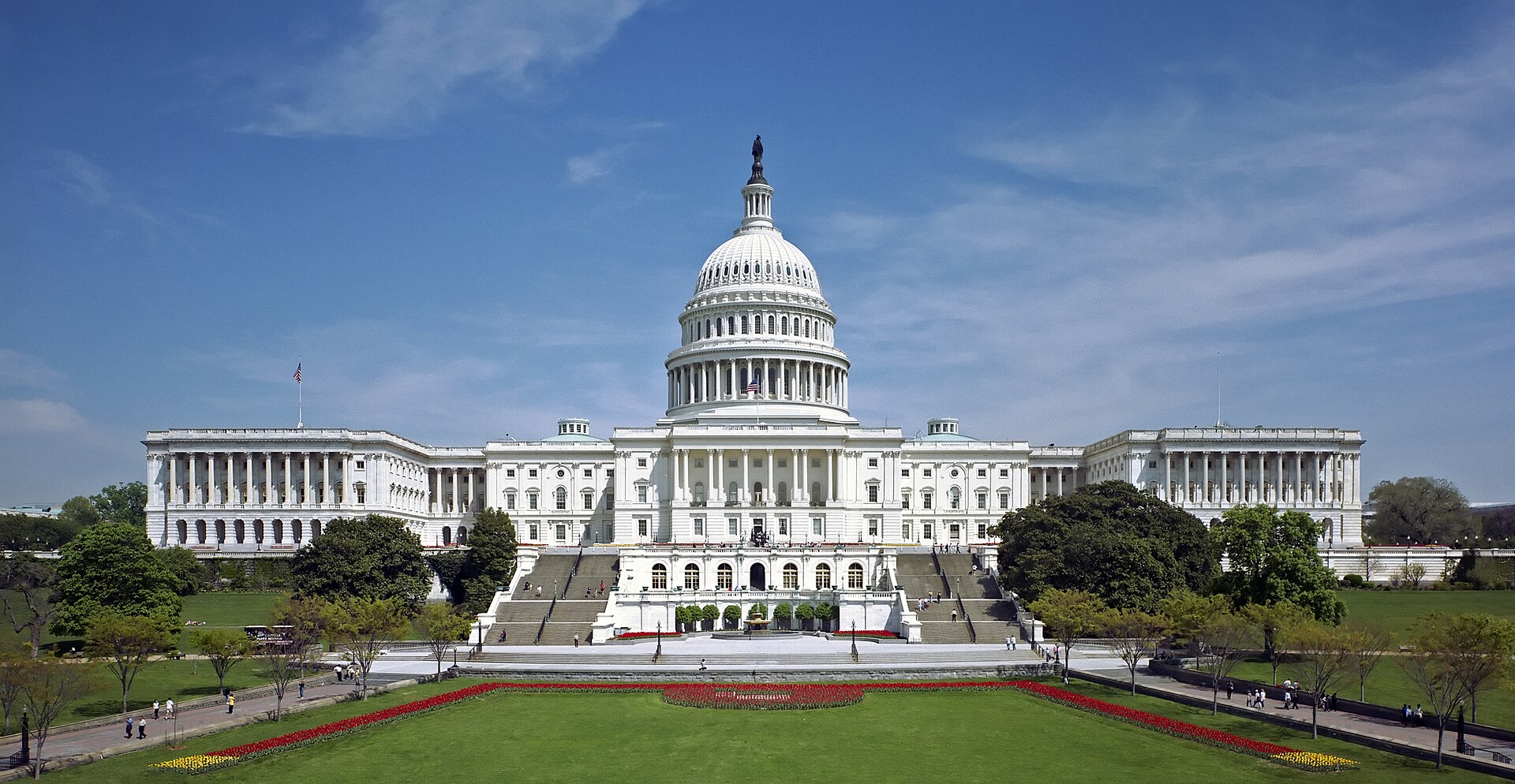
The U.S. Capitol, where the Protect College Sports Act now heads to the House. Photo: Architect of the Capitol, Wikimedia Commons, public domain
Here’s a quick test for any college football fan. Name your team’s starting quarterback. Now name the school he played for two years ago. Now guess where he’ll be next fall.
If you got the first one right and had to think about the other two, congratulations. You’ve been watching college sports lately.
On Monday the Senate passed the Protect College Sports Act, 77-22, which in this Congress counts as a landslide. It still has to get through the House, and it’s not going to happen this week, since the House is out on its pre-election recess and has already fumbled one college sports bill this year. So it isn’t law yet. But this is the most serious attempt anyone in Washington has made to put some structure around the last few years of college sports, and as a fan, I’m genuinely excited about it.
Here’s why.
The Mercenary Problem
I have no problem with players getting paid. They should get paid. Schools make a fortune off these kids, and nobody I know wants to go back to the days when a booster slipping a player a handshake full of cash was a scandal while the school cleared millions on the same guy’s jersey.
My problem is the team hopping. A player has a good year, gets a better NIL offer somewhere else, and he’s gone. Then he does it again. Some rosters turn over so much that you need a program to tell you who’s on the field, and I mean an actual printed program, like it’s 1954.
The bill gives athletes one penalty-free transfer and a five-year eligibility window starting at enrollment or age 19, whichever comes first. You can still leave. There are exceptions for special circumstances. You just can’t treat every December like free agency anymore.
I think that matters for a reason that goes beyond fans being annoyed that they bought the wrong jersey. When a player spends one year at a school, is he really getting an education at that point? Credits don’t always transfer cleanly. Majors change. And the part people skip over: very few relationships get built. You don’t really know your coaches, your teammates or your professors when you’re already halfway out the door.
College sports were supposed to be about players developing and trying to win for a team, a place, a group of guys they came up with. The current setup turns a lot of them into hired mercenaries. Sometimes it works out great for the player. But it’s a strange thing to call “college” when the college part is the first thing to go.
Making the Money Make Sense
The money side of college sports right now is the Wild West, if the Wild West also had collectives, compliance officers and a lot of confused parents.
The bill gives the NCAA the authority to set and enforce standard NIL rules nationwide instead of the current patchwork of state laws. It says an NIL deal has to have a real business purpose and pay something in line with what a non-athlete with a similar profile would get, which is a polite way of saying “no more fake endorsement deals that are really just salary.” Deals over $600 have to be disclosed. And direct revenue sharing from schools to athletes gets a cap, with a base around $20.5 million per school plus a separate retention fund that can push the total close to $50 million.
Does a cap mean some players get less than they would on the open market? Probably. I’m fine with that trade if it means the spending from school to player is out in the open, it’s roughly the same set of rules for everybody, and a program doesn’t have to torch its budget just to keep its roster from getting poached.
The Agents
This is the part of the bill I think gets underrated, and it’s where I’d like to be serious for a minute.
A lot of college athletes are 18, 19, 20 years old and signing contracts with real money in them for the first time. Some have great representation. Plenty don’t. There are agents out there taking enormous cuts from kids who don’t know any better, or whose families trust the first confident guy in a nice jacket who shows up at the house.
The bill requires agents to be certified and registered, with public registries, and it caps their fee at 5 percent of an endorsement contract. Five percent. That’s a number a parent can understand, and it gets a lot of college athletes away from predatory agents who were treating them like an ATM with a jump shot.
The Kids Who Aren’t Going Pro
Here’s the part that I think matters most, even though it’ll get the fewest headlines.
Most college athletes are never going pro. They’re swimmers, rowers, softball players, backup linemen, walk-ons who earned a scholarship. For them, the scholarship is the whole deal. It’s the degree, the thing that makes college affordable, the reason they picked the school.
And for years, that scholarship could disappear. You blow out your knee, and suddenly you’re a “roster management” decision. A school decides it can’t afford a sport anymore, and a kid’s plan for the next three years is gone in one meeting. Every college athlete without a serious shot at the pros has carried that worry around.
Under this bill, a school can’t revoke or reduce an athlete’s scholarship because of injury, athletic performance or roster management. And a big part of the stated reason for the spending cap is to stop the bidding wars that have pushed schools to cut women’s, Olympic and other non-revenue sports in the first place.
If the bill did nothing else, that would be worth it.
Now Do the House
Is this bill perfect? No. The Congressional Black Caucus opposed the House’s earlier version of this effort, the question of whether athletes should be employees is left for another day, and some players are going to make less than they would in a totally open market. Those are real arguments, and I expect we’ll hear them loudly once the House picks this up.
But I’ve spent the last few years watching my favorite sport turn into a trade deadline that never ends, watching agents circle teenagers, and watching schools cut programs to pay for bidding wars. This bill addresses all three.
Overall, it’s a huge step forward, and it’s a win in my book as a college sports fan. The Senate did its part. Now it’s the House’s turn.
And maybe, a couple of years from now, you’ll be able to name your team’s quarterback and the school he played for two years ago, because it’ll be the same school.


0 Comments
Log in or sign up to join the conversation.
No comments yet. Be the first to share your thoughts!