
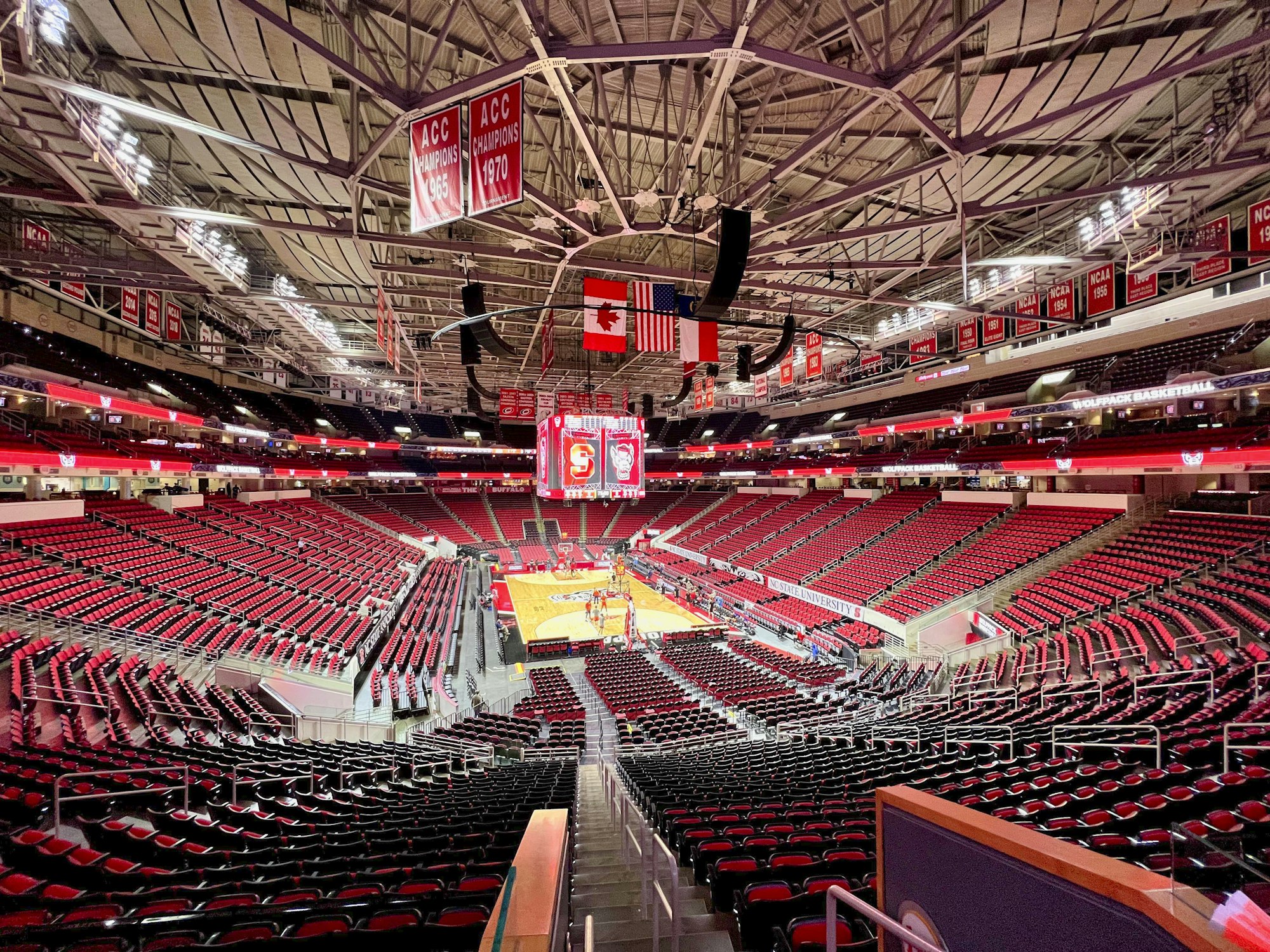
College basketball in mid-October: empty arenas, full rankings. Photo: Gene Gallin, Unsplash
The most important preseason ranking in college basketball is made by a former weatherman. I mean that as a compliment.
Ken Pomeroy grew up in Alexandria, Virginia, a math kid who loved box scores. He studied civil engineering at Virginia Tech, worked as an engineer, got bored, went back to school for meteorology at Wyoming and spent 12 years forecasting the weather for the National Weather Service. One night he was watching an Air Force game, and the broadcast kept quoting scoring averages without accounting for how slowly Air Force played. That annoyed him enough to start a website. That was 2001.
In 2011 he kept the rankings free and put the deeper stuff behind a paywall ($20 a year at the time), figured almost nobody would pay, and people paid. He left the weather service not long after. Now coaches build game plans off his numbers, the NCAA selection committee looks at them, and Dick Vitale has said “KenPom” on national television, which Pomeroy has described as surreal.
What the numbers mean
The idea is simple. Scoring averages lie. A team that plays fast will score more than a team that plays slow, and a team with an easy schedule will look better than it is. KenPom measures points scored and allowed per 100 possessions and adjusts for who you played. The number everybody quotes is the net rating: roughly how many points a team would beat an average Division I team by over 100 possessions.
The preseason version is a forecast, not a record. It leans on returning production, blue-chip freshmen and impact transfers, with a little weight on a coach’s track record, and it fades out as real games pile up. Think of it as the seven-day forecast. Useful, but you still look out the window.
The top of the board
Duke is No. 1 with a net rating of 34.42, top three in the country on both offense and defense. Florida is second at 33.38 and has the No. 1 offense. After those two there’s a real drop. Houston is third at 31.66, the only other team over 30, and the model projects Kelvin Sampson’s group to have the best defense in the country, which will surprise nobody who has ever played Houston.
Duke lost Cameron Boozer and Isaiah Evans to the NBA and still starts on top, which tells you something about the rest of the roster. Six players are back, including Patrick Ngongba II and Caleb Foster. The freshman class finished first in 247Sports’ rankings and second in ESPN’s, and it includes Joaquim Boumtje Boumtje, a 7-footer who played for FC Barcelona’s youth program and whose dad played at Georgetown and in the NBA.
Then there’s John Blackwell, who transferred in from Wisconsin. This one hurts. Blackwell was my personal favorite, and it stung to see him leave. I wish him well, even if it’s going to be strange watching him in that uniform.
Illinois is fourth, with the No. 2 offense in the country and a lot of continuity, since most of last season’s roster is back. Defense is the question (22nd). Then the Big 12 takes over: Arizona is fifth, Iowa State sixth, Kansas eighth and Texas Tech 12th. Count Houston and that’s five Big 12 teams in the top 12.
A few others worth a look: Louisville is 17th (plus-24.49) in Pat Kelsey’s third season, defending national champion Michigan starts 28th, and Marquette, coming off a 12-20 season, is 34th.
Where the computer and the humans disagree
The biggest gap is UConn. ESPN’s preseason top 25 has the Huskies fifth. Fox Sports has them sixth. The Big East’s coaches picked them to win the league. KenPom has them 11th.
Some of the gap is easy to explain. Alex Karaban and Tarris Reed are gone, both first-round picks, and Solo Ball will miss the season after wrist surgery. But Silas Demary Jr. and Braylon Mullins are back, Na’jai Hines came over from Seton Hall, Nik Khamenia came from Duke, and there’s a lot of talent on this roster. These are talented kids who clearly want to play for Danny Hurley.
My read is that the model doesn’t see Demary or Mullins as a true take-over-the-game player yet. I think both of them can be. Mullins hit a huge three against Duke in last season’s Elite Eight, for anybody keeping track of how UConn does against the computer’s No. 1.
Braylon Mullins celebrates a second-half three against Duke in the Elite Eight in Washington, D.C., March 29, 2026. Photo: Emilee Chinn/Getty Images
There’s a pattern here, too. KenPom tends to need to see UConn before it believes in UConn, and it warms up as the season goes. I see the same trust gap with Gonzaga. And teams in the big conferences tend to climb as the data comes in, because the model cares about who you played and by how much, not just whether you won. A close loss at a good team can actually help you.
Iowa State is the opposite case. ESPN’s top 25 left the Cyclones out entirely (they’re in its “next five”). Fox has them 14th. KenPom has them sixth.
I’m not surprised, and a big reason is Tamin Lipsey. He’s back for a fifth season after a judge in Indiana granted a preliminary injunction that gives nearly 100 former college athletes, Lipsey included, another year (the NCAA is fighting it). Last season he averaged 13.5 points, 5.1 assists and 2.3 steals for a team that went 27-8 and made the Sweet 16, and he’s a three-time pick for the All-Big 12 Defensive Team. He’s electric to watch. The program’s track record helps, too. Under T.J. Otzelberger, Iowa State’s final KenPom ranking has averaged about 8.7 over the last three seasons, including seventh last year.
It’s a forecast, and the man who made it used to forecast for a living, so he’d be the first to tell you they change. Check back in February. In the meantime, if you’re headed to Ames this winter, bring an umbrella.
0 Comments
Log in or sign up to join the conversation.
No comments yet. Be the first to share your thoughts!