
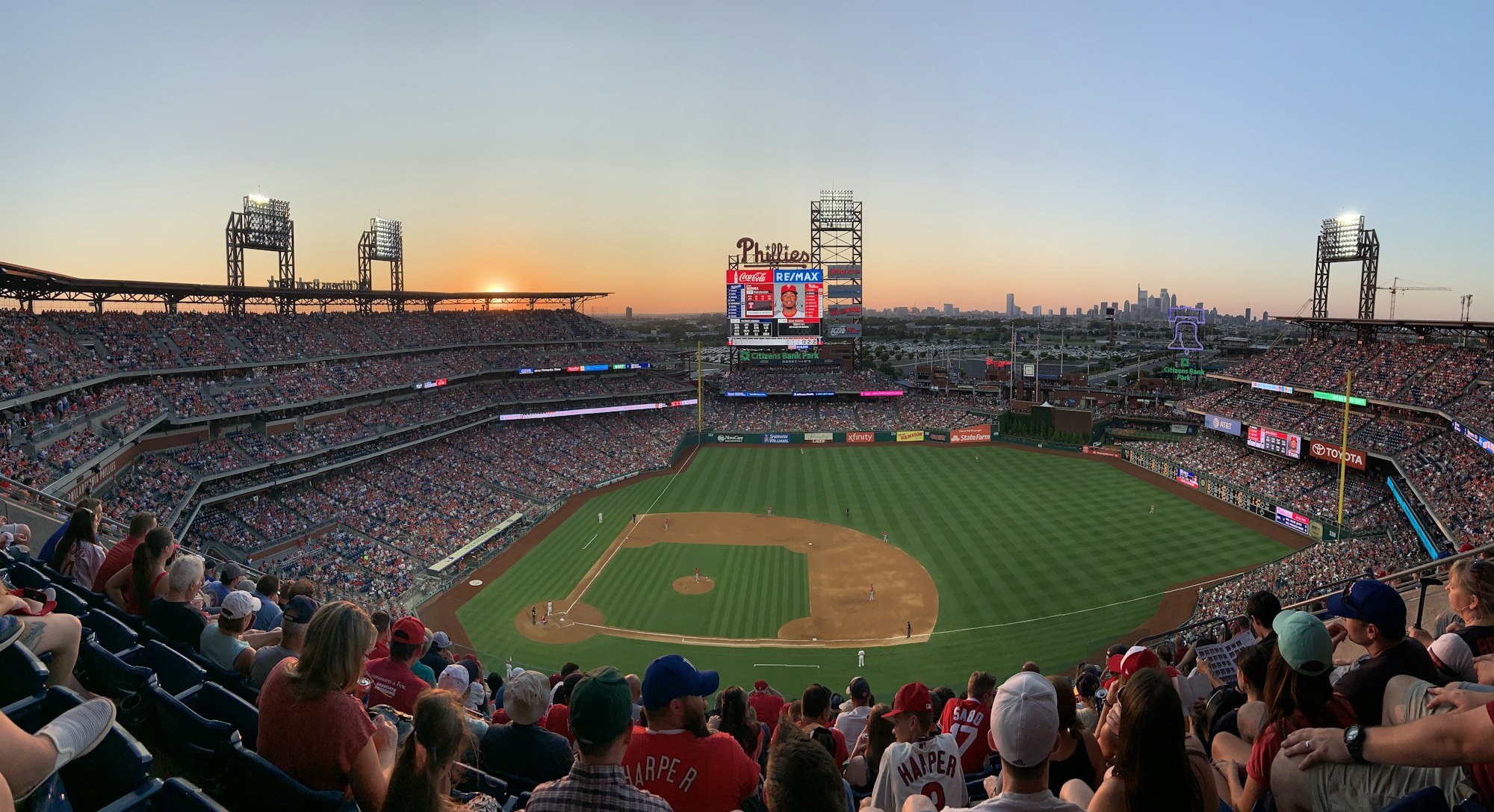
A full house at Citizens Bank Park. Under MLB’s proposal, every team would get four fewer home dates a year. Photo: Ryan Carpenter, Unsplash
Baseball plays too many games. I’ve believed that for a long time, and last Thursday the league more or less agreed with me.
Rob Manfred’s office handed the players’ union a proposal on Oct. 8 that would cut the regular season from 162 games to 154, starting in 2029. The schedule would shrink from 187 days to about 180. Most teams would get Mondays off, with room for up to two nationally televised Monday games, and teams that do play on a Monday would get that Thursday off instead. Monday holidays would still have games. Every team would play four day-night doubleheaders, one against each division rival. Salaries wouldn’t change, though bonus thresholds tied to games played would.
For the history people: 154 was the standard starting in 1904. The American League went to 162 when it expanded in 1961, and the National League followed in 1962.
I’m in. On all of it.
Rob Manfred with Nationals owner Mark Lerner at Nationals Park on April 6, 2015, in his first season as commissioner. Photo: Rob Carr/Getty Images
The grind is the reason. If you’ve followed a team through a summer, you’ve seen what a stretch of 17 games in 17 days does to a roster. The bullpen gets thin and the regulars need days off they can’t get. Eight fewer games and a guaranteed day off every week make the season more sustainable for the people who actually play it. MLB spokesman Glen Caplin said a weekly off day “is good for player health.” I agree with him. I’ll also note that baseball would officially be on the side of everybody who hates Mondays.
The math is better than it looks, too. Right now it’s 162 games in 187 days, which leaves about 25 days off, dropped wherever the schedule happens to put them. Under the proposal it’s 154 games in about 180 days, with four of them doubled up, which works out to roughly 30 days off, and most of them land on the same day every week. Players can plan around a Monday. Nobody can plan around a random Tuesday in July.
The playoff changes are good, too. The Division Series would go from best-of-five to best-of-seven, played over 11 days instead of nine, with off days before Games 5 and 7 on top of the usual travel days. The Wild Card Series would stay best-of-three at the higher seed’s park, with an extra off day after Game 1. Only two games would be played on each of the first three days of the postseason, and the early-round afternoon games would go away.
That last part matters to me more than anything else in the proposal. Right now the first round can have four games in a day, which means some of them start while most people are at work. The biggest games of the year shouldn’t be something you catch on the radio at your desk. More rest means better pitching in October, and fewer weekday afternoon games means more people can actually watch. Put the best baseball where the most people can see it.
Where it loses me
Starting next season, under the proposal, higher seeds would get to pick their opponents in the first two rounds. The No. 3 seed in each league would choose whether to host the No. 5 or the No. 6 seed in the Wild Card Series. The No. 1 seed would pick which wild-card winner it plays in the Division Series. MLB’s pitch is that it would create compelling storylines and intensify rivalries.
I think it’s a gimmick.
Every front office in baseball has an analytics department that can tell you, before the champagne dries, which possible opponent has the worse bullpen and the worse last 20 games. Nobody is going to pick an opponent to settle a grudge. Nineteen times out of 20, the top seed will pick whichever team the numbers say is easiest to beat that week. That means more lopsided series, not fewer, from a format that’s supposed to make October more interesting.
Look at when the choice gets made, too. The No. 1 seed would pick right after the Wild Card Series, so it gets to see which survivor just burned its ace to get there. If one wild-card winner has its rotation lined up and the other needed its closer for two innings to survive Game 3, the choice makes itself.
I understand the dream scenario. The team that gets picked as the soft one goes out and wins the series, and everybody gets a great underdog story for a week. It could happen. I just don’t think it would happen often enough to build the bracket around it. If MLB thinks the current bracket is unfair, reseed it straight up by record, so the best team left plays the worst team left every round. It’s boring, and it’s fair. Or leave the bracket alone.
The fine print
One more thing to keep in mind: all of this showed up in the middle of a labor fight. The current collective bargaining agreement expires Dec. 1. MLB has also proposed a salary cap, and the players’ association said the league’s proposals are “contingent on players’ agreement to a salary cap,” a system the union says “guts player rights and compensation.” The owners are expected to lock the players out. So none of this is happening tomorrow, and some of it may be a bargaining chip.
I hope the schedule part survives whatever happens this winter. Baseball plays too many games. Fix that, and leave the bracket alone.


0 Comments
Log in or sign up to join the conversation.
No comments yet. Be the first to share your thoughts!