
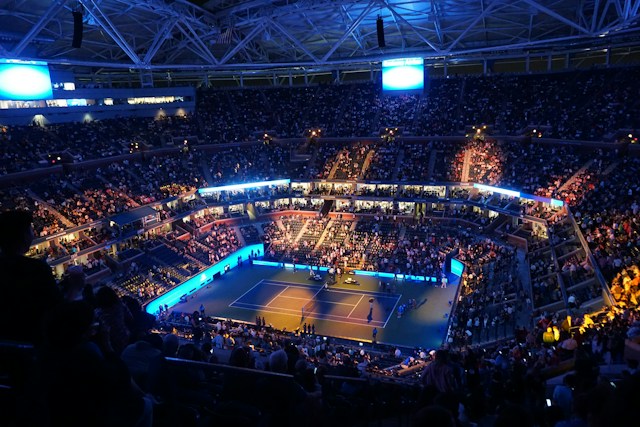
The ace was clocked at 146 miles an hour, out wide, unreturnable, and Ben Shelton turned and grinned at his box before the ball had even landed. It was 3:33 on Wednesday morning at Arthur Ashe Stadium, the latest a match has ever finished at the US Open, and the people who’d stuck around were on their feet.
He had just beaten Carlos Alcaraz. Six-seven, six-one, six-three, one-six, seven-six in a deciding tiebreak. Four and a half hours. And it was the first time in four tries Shelton had ever beaten him.
Start with what that actually means, because the number is almost funny until you sit with it: Shelton was 0-17 in his career against Top 3 opponents before Tuesday night bled into Wednesday morning. Zero and seventeen. Every time an American man his age has stood across the net from the best player alive, he has lost, and usually not close. That’s what it has looked like for a decade and a half to be a promising young American man in this sport: promising, then losing to whoever is actually great. And it’s not as if Shelton has been treading water waiting for his shot. He’s won two Masters 1000 titles this year, including one last month in Montreal, and back in May he became the first American man to win a clay title at the ATP 500 level or higher since Andre Agassi in 2002. He was a top-five player as recently as November. He just kept running into the handful of guys who are better than absolutely everybody, including him.
Alcaraz is one of those guys, worth saying plainly since it’s the whole point: seven Grand Slam titles, the youngest man ever to complete the career Grand Slam, the two-time defending champion at this exact tournament. He had also won all thirteen of his previous matches against American men at majors, without exception, and been pushed to a fifth set in exactly two of them. Both times it was Frances Tiafoe. He also hadn’t played a major since January, sidelined four months by a wrist injury that cost him the French Open and Wimbledon both. He was sick to his stomach before the fifth set even started, and played it anyway. That context doesn’t make the win smaller. It’s why the match needed four and a half hours and a fifth-set tiebreak instead of three sets and a handshake, and Shelton still had to be the better player at the end of it, legs gone, four in the morning.
Now the history, because this is where it gets bigger than one match. Andy Roddick beat the world No. 1 to win the 2003 US Open. He was 21. No American man has won a major since. That’s twenty-three years now, one of the longest droughts in the sport, and it survived the entire Federer-Nadal-Djokovic era without so much as a real scare. Roddick himself said going into this tournament that he thought this was a real chance for it to finally end. He’d know.
The closest anyone came was four years ago, almost to the day, at this same tournament. Frances Tiafoe beat Rafael Nadal in the fourth round, ending a 22-match Grand Slam winning streak, and became the first American man to reach a US Open semifinal since Roddick himself, and the first Black American man to do it since Arthur Ashe in 1972. By then, American men had gone 74 consecutive majors without a title. Then a 19-year-old named Carlos Alcaraz beat Tiafoe in five sets and went on to win the whole tournament, becoming the youngest world No. 1 in tennis history. Tiafoe’s breakthrough became someone else’s origin story instead.
That’s the part that makes this week feel different. Shelton didn’t lose to the guy who becomes the problem. He beat him, four years and seven majors later, once Alcaraz had already turned into exactly the player everyone worried he’d become. And now Shelton plays Tiafoe in the semifinal, guaranteeing an American in the final for the second time in three years, after Taylor Fritz did it in 2024 and lost to Sinner anyway.
That last part is the whole ballgame. Reaching a final was never really the problem. Roddick reached finals for years after 2003 and never got back to a title. Fritz reached one two years ago and went home the same way everyone else has. What ends a drought like this one is being the best player on a Sunday, not the second-best player in September. Beating Alcaraz doesn’t do that by itself. It just means the guy with an actual chance to do it also just beat the man who’s usually the reason nobody does.
Shelton is 23. He’ll be back on a practice court in a day or two, working on the same left-handed serve that got him out of that fifth set. Whatever happens against Tiafoe, whatever happens after that, the story of an American finally doing this again now has a real chapter in the middle of it, written at 3:33 in the morning, by a guy who was 0-17 against players like this until he wasn’t.
0 Comments
Log in or sign up to join the conversation.
No comments yet. Be the first to share your thoughts!