
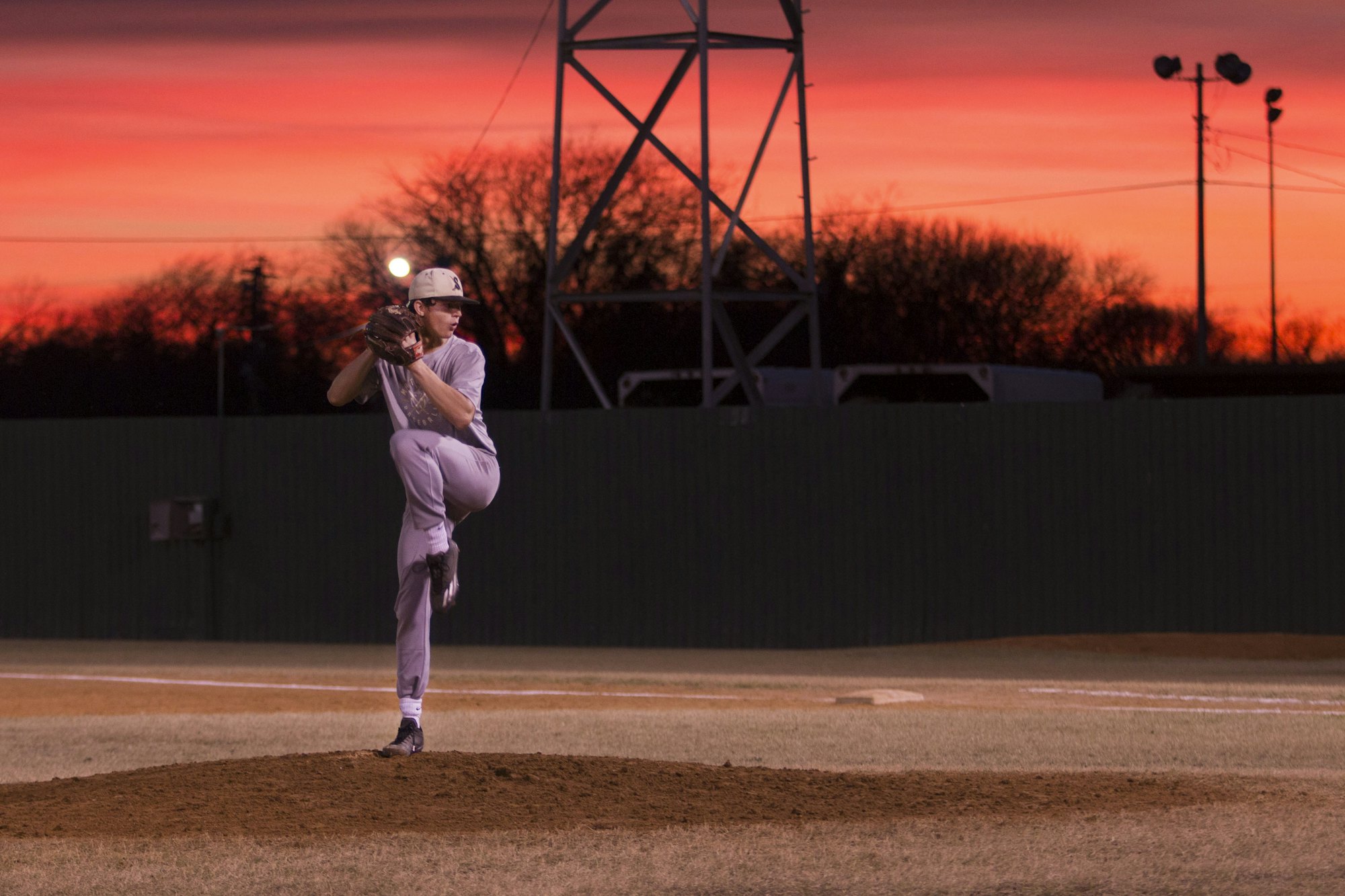
A pitcher delivers at sunset in Seguin, Texas. In October, I want six innings and no more than two earned runs. Photo: Chris Moore, Unsplash
An official quality start is six or more innings with three or fewer earned runs. Six and three every time out is a 4.50 ERA, which is fine for a Tuesday in June. In October I want more from a starter, so I made my own version: six or more innings, two or fewer earned runs. I’m calling it the Josh quality start, or JQS. It’s my site, so nobody can stop me.
Then I went through every postseason start from 2022 through 2025: 342 starts, 84 of them JQS. I wanted to know whether two runs is the right bar, and what kind of pitcher clears it.
Is two the right number?
My reasoning was that a starter’s job in October is to hand the bullpen a lead. Teams that led after six innings won 87% of the time, so that part checks out. Postseason teams scored only a little less through six innings (2.80 runs, against 3.00 in the regular season), but the third run costs a lot more. Teams that allowed two runs through six won 55% of their October games, close to the 57% they won in the regular season. Teams that allowed three won 37%, down from 47%. Two is the most a team can give up through six in October and still be favored.
Whole outings say the same thing. When a starter threw a JQS in October, his team went 64-20. When he went six-plus and allowed exactly three, which still counts as an official quality start, his team went 4-5, about what that outing does in the regular season (46.5%).
What kind of pitcher gets there?
Next, I sorted every postseason starter into four types based on his own regular season that year:
- Dominator (strikeout rate over 30%, walk rate under 6%): 10 of 17 starts, 59%
- Power flyball (strikeouts over 28%, walks 7.5% to 9%): 8 of 18, 44%
- Groundball ace (groundball rate over 50%, under 1.0 homers per nine): 18 of 45, 40%
- Command artist (strikeouts 22% to 25%, walks under 4.5%): 2 of 8, 25%
- None of the four: 49 of 233, 21%
Dominators had the best rate, and they were the only group that pitched better in October than in their own regular seasons (53%). Groundball aces had the most JQS of the four types, and their teams went 16-2 in those games.
The dominator sample is small, though. Only 14 pitcher-seasons in all of baseball hit both marks from 2022 to 2025. Tarik Skubal threw five of the group’s 10 JQS himself. Without him, dominators went 5 for 11 (45%), still well ahead of the 26% rate for all starters, but on 11 starts.
Tarik Skubal pitches against Cleveland at Comerica Park on Sept. 18, 2025, 12 days before he struck out 14 Guardians in the Wild Card opener. Photo: Duane Burleson/Getty Images
Length separated the groups more than runs did. Starters outside the four types got pulled before six innings with two or fewer earned runs in 41% of their October starts, after about 70 pitches on average. Dominators, once in 17.
The common thread is strikeouts minus walks. Starters whose strikeout rate beat their walk rate by 25 percentage points or more threw a JQS in 48% of their October starts. Under 15 points, 14%. Gerrit Cole missed the dominator cut in 2022 by three-tenths of a point of walk rate, and he, Zack Wheeler and Yu Darvish didn’t fit any of my four types in the seasons they pitched in October. All three are on the next list.
Who thrives
Then I compared the 36 pitchers with at least four October starts with their own regular seasons in the same years. As a group they fell from 44% to 31%. Six threw a JQS in more than half their October starts, and all six beat their regular-season rate:
- Tarik Skubal (Dominator, 2024 and 2025): 5 of 6, 83%. Regular season: 65%.
- Zack Wheeler (no archetype): 8 of 11, 73%. Regular season: 60%.
- Yu Darvish (no archetype): 5 of 7, 71%. Regular season: 39%.
- Nathan Eovaldi (Groundball ace, 2023): 4 of 6, 67%. Regular season: 32%.
- Gerrit Cole (no archetype): 5 of 8, 63%. Regular season: 52%.
- Yoshinobu Yamamoto (no archetype in 2024; Power flyball and Groundball ace in 2025): 5 of 9, 56%. Regular season: 44%.
Wheeler leads in volume with eight, and the Phillies won six of those games. Skubal’s one miss came in Game 5 of the 2024 ALDS in Cleveland, when Lane Thomas hit a grand slam off him. (Detroit traded him to the Dodgers this summer, which seems unfair to everyone else.)
Zack Wheeler pitches in the first inning of Game 1 of the 2022 NLCS in San Diego. He threw seven scoreless innings. Photo: Ronald Martinez/Getty Images
Who fades
There are two ways to fade. Some pitchers got hit:
- Max Scherzer (Dominator in 2022, no archetype in 2023 and 2025): 0 of 7, 6.28 ERA. Regular season: 45%.
- Max Fried (Groundball ace; also a Command artist in 2022): 1 of 5, 9.16 ERA. Regular season: 53%.
- Carlos Rodón (no archetype): 1 of 6, 6.92 ERA. Regular season: 48%.
- Freddy Peralta (Power flyball in 2023, no archetype since): 0 of 5, 5.55 ERA. Regular season: 37%.
- Luis Severino (no archetype): 0 of 5, with three or more earned runs in four of them. Regular season: 36%.
Max Scherzer heads to the dugout after the first inning of Game 3 of the 2025 World Series at Dodger Stadium. He gave up three runs in 4 1/3 innings. Photo: Patrick Smith/Getty Images
Others pitched well and got pulled anyway:
- Ranger Suárez (Groundball ace in 2022 and 2024, no archetype in 2023): 0 of 8, 1.49 ERA. Pulled with two or fewer earned runs seven times.
- Matthew Boyd (no archetype): 0 of 6, 1.69 ERA. Pulled early all six times.
- Tanner Bibee (no archetype): 0 of 5, 3.10 ERA. Pulled early all five times.
Suárez and Boyd have the two lowest ERAs of anyone with four or more October starts, and neither has a JQS. Suárez never got through six innings in eight tries.
Kevin Gausman (no archetype) is somewhere in between. His 0 for 7 against a 52% regular-season rate is the biggest drop on the board, but three of his 2025 starts ended one out short of six with two or fewer earned runs, and two more were six-plus innings with exactly three. Two official quality starts, zero Josh quality starts.
Follow the money
Last question: are the pitchers who do this the ones getting paid? Mostly, yes. I matched every start to the average annual value of the pitcher’s contract that season. Starters making $25 million or more threw a JQS in 44% of their October starts. Under $5 million, it was 19%, and the rate rises at every pay level in between.
The expensive guys didn’t give up fewer runs, though. They allowed three or more earned runs in 36% of their starts; the cheapest group, 31%. The difference was how long they got to pitch. In starts where a $25 million pitcher allowed two or fewer earned runs, he finished six innings 69% of the time. An under-$5 million starter in the same spot finished six 28% of the time. Suárez was making under $5 million in seven of his eight October starts.
I can’t tell from this whether managers are right to trust the expensive arms or whether the cheap ones would have held up. The data only shows who got the chance. And two names cut against the trend. Scherzer, at a $43.3 million average annual value, went 0 for 4 in 2022 and 2023. Skubal went 5 for 6 while making $2.65 million and then $10.15 million. Nobody overlooked him; arbitration kept his salary down.
I’m one guy with a spreadsheet and a stat I named after myself, so I could be wrong about some of this. But if I’m picking a starter for a big October game, I want the one who misses bats without walking people, and I want a manager who lets him get through six.
How I did this: Every start comes from Retrosheet box scores and play-by-play for the 2022 through 2025 regular seasons and postseasons. Archetypes use each pitcher’s own regular season that year; a few pitchers fit two types and count in both, and openers and pitchers who faced fewer than 150 regular-season batters don’t get a type. Pay is the average annual value of the contract covering that season (the one-year salary for players without a multiyear deal), from The Baseball Cube, checked against news reports. Shohei Ohtani is left out of the pay numbers because his contract also pays him to hit. The information used here was obtained free of charge from and is copyrighted by Retrosheet. Interested parties may contact Retrosheet at “www.retrosheet.org”.


0 Comments
Log in or sign up to join the conversation.
No comments yet. Be the first to share your thoughts!